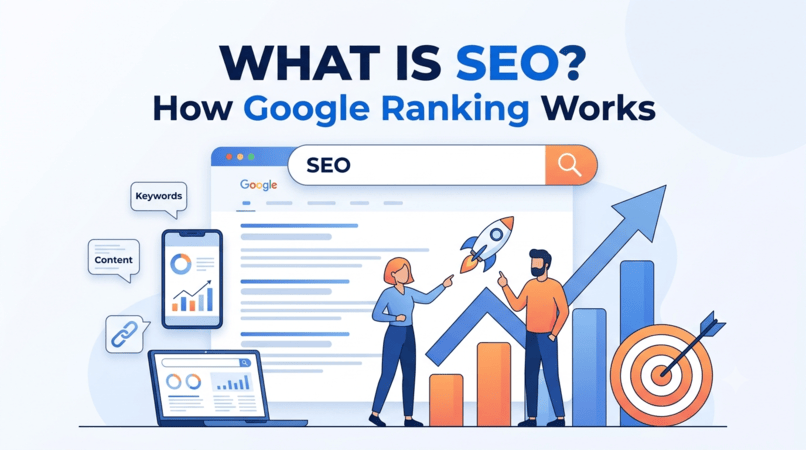
SEO (Search Engine Optimization) is the work you do to help your website show up higher on Google when people search for something you offer, and Google ranking is simply the position your page lands in those results. Position 1 gets the most clicks, and most people never make it to page two, which is why ranking well matters so much. Google decides who ranks where in three steps: it finds pages (crawling), stores them (indexing), and then sorts them by usefulness and trust (ranking), as explained in Google’s guide to how Search works. The biggest factors behind that order are helpful content, relevant keywords, quality backlinks, a fast mobile-friendly site, and strong trust signals. SEO does take time, and most new websites need around 3 to 6 months to see real movement, but the traffic you earn is free and keeps coming long after you publish. To get started, pick the right keywords, write content that truly answers the searcher’s question, fix your site’s technical basics, and earn links from good websites.
What Is SEO, Really?
Think about the last time you searched for something on Google. Did you click on the fifteenth result? Almost certainly not. You clicked one of the first few.
SEO is how businesses earn those spots.
The full form is Search Engine Optimization. It means making your website easier for search engines to understand and more valuable for the people using it. Google itself describes this in its SEO Starter Guide, a free resource for anyone who owns or manages a website. When you do SEO well, Google shows your pages to people who are actively looking for what you offer. That traffic is called organic traffic, and unlike ads, you don’t pay for each click.
That’s why SEO is one of the pillars of digital marketing. A good blog post can bring in visitors for years, while an ad stops the moment your budget does.
What Does “Google Ranking” Mean?
Your Google ranking is the position your page holds for a specific search. Rank #1 for “digital marketing agency” and you’re the first thing people see. Rank #27 and you’re practically invisible.
Two things are worth knowing here:
- Rankings are per keyword. One page can rank #3 for one phrase and #40 for another.
- Rankings change. Google updates its systems constantly, and your competitors are working too. Ranking is something you maintain, not something you win once.
How Does Google Decide Who Ranks First?
Google’s job is to give people the best answer as fast as possible. To do that, it follows three steps.
Step 1: Crawling. Google sends automated bots (Googlebot) across the internet, following links from page to page to discover content.
Step 2: Indexing. Google reads what it found, works out what each page is about, and stores it in a giant database called the index. If your page isn’t indexed, it can’t rank. Period.
Step 3: Ranking. When someone searches, Google pulls the most relevant pages from the index and orders them using hundreds of signals. That’s where all your SEO effort pays off.
The Google Ranking Factors That Matter Most
Nobody outside Google knows the exact formula, but years of testing and Google’s own guidance point to the same core factors.
1. Helpful, original content
This is the big one. Google wants pages that fully answer what the searcher was after. Thin, copied, or padded content rarely wins anymore. Write like you’re explaining something to a friend who genuinely wants to understand.
2. Search intent
Before writing anything, ask what the person really wants. Someone searching “what is SEO” wants an explanation. Someone searching “SEO agency near me” wants to hire someone. If your page doesn’t match the intent, it won’t rank, however well it’s written.
3. Keywords used naturally
Include the phrases people search for in your title, headings, and opening paragraph, and then just write normally. Forcing a keyword into every sentence reads badly and can hurt you.
4. Backlinks
When other reputable websites link to you, Google reads it as a recommendation. Ten links from respected sites in your field beat a hundred from random, low-quality ones.
5. E-E-A-T
This stands for Experience, Expertise, Authoritativeness, and Trustworthiness. Show who’s behind your content, share real experience, cite reliable sources, and keep your facts accurate.
6. Page speed and mobile experience
Most searches happen on phones. If your site is slow or awkward on mobile, visitors leave, and Google notices.
7. Site security and structure
An HTTPS site with clear navigation and no broken pages tells Google (and visitors) that you’re legitimate.
The Three Types of SEO
| Type | What it covers | Examples |
| On-page SEO | What’s on your pages | Titles, headings, content, images, internal links |
| Off-page SEO | What happens elsewhere | Backlinks, brand mentions, guest posts |
| Technical SEO | How your site works behind the scenes | Speed, sitemap, mobile setup, crawlability |
10 SEO Tips You Can Start Using Today
- Start with keyword research. Free tools like Google Keyword Planner and Google Search Console show you what people are actually typing.
- Go after specific phrases first. “SEO tips for small bakery websites” is easier to rank for than “SEO.”
- Write a title people want to click. Keep it around 60 characters, with your main keyword near the front.
- Don’t ignore your meta description. About 150 to 160 characters that clearly say what the reader will get.
- Structure your content. One H1, then H2s and H3s, short paragraphs, and lists where they help.
- Give real value. Add examples, your own experience, or details competitors skip.
- Optimize your images. Compress them, name files clearly, and add descriptive alt text.
- Link your own pages together. Internal links help visitors and Google move around your site.
- Earn links naturally. Publish useful guides, contribute guest posts, and build genuine relationships in your industry.
- Check your results and improve. Google Search Console will show you which pages are working and which need a refresh.
Mistakes That Quietly Hurt Your Rankings
- Keyword stuffing. It makes content awkward and Google sees through it.
- Copying or spinning content. It adds nothing new, so there’s no reason to rank it.
- Buying cheap backlinks. Spammy links can get you penalized.
- Ignoring mobile. A page that’s painful on a phone loses people in seconds.
- Publishing and forgetting. Old, outdated pages slowly slide down.
- Giving up too early. SEO is slow at first. Many people quit right before it starts working.
How Long Does SEO Take?
Honestly, it depends. A brand-new site in a competitive niche might take six months or more to see solid results. A site with some authority targeting less competitive keywords can move faster. What matters is consistency: publishing helpful content regularly and improving what you already have.
SEO and AI Search: What’s Changing?
Google now shows AI-generated summaries on many searches, and plenty of people ask for AI tools instead of typing keywords. Does that kill SEO? No, but it raises the bar. Pages that answer questions clearly, show real expertise, and stay accurate are the ones most likely to be surfaced and cited. In other words, the fundamentals matter more than ever, not less.
Final Thoughts
SEO can feel overwhelming at first, but it really comes down to a few habits: understand what your audience wants, create content that genuinely helps them, keep your site fast and clean, and earn trust over time. You don’t need to do everything at once. Pick one or two things from this guide, do them well, and build from there.
Want help growing your website’s traffic? Our digital marketing team can audit your site, find quick wins, and build an SEO plan around your business goals. [Get in touch for a free consultation.]
Frequently Asked Questions (FAQs)
1. What is SEO in simple words?
SEO is the process of improving your website so Google can find it, understand it, and show it to people searching for what you offer.
2. What does Google ranking mean?
It’s the position your page appears in for a particular search. The higher you rank, the more people see and click your page.
3. How does Google rank websites?
Google crawls pages, indexes them, then ranks them based on relevance, content quality, backlinks, user experience, and trustworthiness.
4. How long does it take to rank on Google?
Typically 3 to 6 months or longer, depending on competition, your site’s authority, and how consistent your content is.
5. Is SEO free?
You don’t pay Google for organic rankings, but SEO does take time, effort, and sometimes paid tools or professional help.
6. What’s the difference between SEO and SEM?
SEO earns unpaid traffic through optimization. SEM (Search Engine Marketing) includes SEO plus paid ads like Google Ads.
7. Do backlinks still matter?
Yes. Links from relevant, trusted websites remain one of the strongest signals of authority.
8. Can I do SEO on my own?
Absolutely, at least the basics. If your industry is competitive or you want faster results, an experienced SEO team can save you time and mistakes.
9. What are the best free SEO tools?
Google Search Console, Google Analytics, Google Keyword Planner, and PageSpeed Insights are all free and a good place to start.
10. Why isn’t my website ranking?
Usually it’s one of these: the site is new, the content is thin, there are technical problems, the site is slow, you have few backlinks, or you’re targeting keywords that are too competitive.